Showing posts with label Hyundai. Show all posts

Tuesday, December 7, 2010

New Hyundai Tucson


New Hyundai Tucson news presence in the homeland very Santer sounded. One of them, carrying on AUTOMOTIVE last issue concerning the two variants that will appear in Indonesia. So, no need to think long exclusive meeting invitations from PT Hyundai Mobil Indonesia (HMI) for a little national journalists option to try it out directly in the neighboring country. Interesting first trip was adorned this SUV drives sleeker city of Singapore, crossed over to Johor Bahru and Kuala Lumpur and drove to Genting Highlands, Malaysia. What's it like? Come out mimic kebet!
In an AC system, equipped with sensors that Tucson will turn off the AC compressor at high speed. This looks at the 'MAX A / C'. If this button is pressed, then the AC will work fully. However, if disabled, compressor would die on certain conditions.

So also with the alternator. This current generation devices to work at the time of deceleration. So, there is a kind of electrical coupling in pulien which will be free when they're full acceleration. Bearing system to keep even though the gas was released. This feature is intended to allow more economical fuel consumption Tucson.

Toh, steady energy. Especially when it crossed into the Johor and crossing Lebuhraya (toll road) as far as 368 km to Kuala Lumpur. Transmission 6 Tucson acceleration was smooth, both when the kick down or moved manually through the lever steptronic model. Imperceptibly, even though Malaysia's speed limit is only 110 km / h, Tucson capable search up stuck electronically controlled top speed of 190 km / h,

So, wait for the arrival of Tucson on IIMS later. But the new unit is available around September, because of Tucson will be assembled CKD in the homeland. Of course the effect can be made kompetitif possible price. We'll see!

Okay, just enter the items into the trunk. Very relieved! Three large suitcases, one of which exceeds the size of the 'cabin size' aircraft can be lined up side by side. Then there can be stacked on top tote bag. If you need a more spacious space, 60:40 split back seat that could put to sleep.

Entrance to the cabin, was also relieved. To measure 185 cm posture, it can still sit comfortably in the front seat and back. Create a special driver's seat, high-low setting can be reclining and sliding apart. Set the ideal driving position was easy because there are not even feature telescopic tilt steering.

Travel preparation was done by setting the electric mirror and mirror center who has a bookmark feature strong and wind directions. While the audio in the center dash features a reading of the CD format MP3. There are auxiliary socket for an MP3 player and audio from the USB jack or an iPod for reading flash. Oh yes, must provide special iPod USB power cable because they can not use standard data cable.

Operation of the audio and AC pretty easy because the ergonomic position. Moreover there are buttons on the steering wheel audio controls. Quite easy and does not reduce the concentration of driving. Some features are quite different between the two cars. For example panoramic roof earlier.

In addition, the highest model of light blue, Tucson is also equipped with keyless entry. No need to create keys in the car. Want to start one live press the button. Then power windows have auto feature both down and up (another type of auto down only). Included also features an Electronic Stability Programme (ESP) and Hill Descent Control (HDC), which already exists at the highest variance. According to Edwin, the highest variant has not been planned into Indonesia. Spek roughly similar to the actual black Tucson.

Turn the ignition key and get ready to move to Orchard Road and goes around the Esplanade. Theta II, 2000 cc engine feels quite smooth. Although a little steering wheel vibrates when played as a stop. Ah, apparently still use hydraulic power steering.

Matic 6 SPEED

Landed in the Changi Airport, Singapore, with cloudy weather conditions had made the heart dag-dig-dug. Fortunately, the pilot and copilot bule able to make iron bird landed safely. Especially after walking toward the parking lot and saw the original form of the New Hyundai Tucson. Balls that had shriveled returned volatile.

Handsome is also the original form of Tucson. Click amazed about the designs came from colleagues who accompany HMI. Oops, this was also the first time they met Tucson Anyar! Turning once or twice looking exterior detail, felt more mature than previous generations.

There are two Tucson are available. One of them complete with a panoramic roof. But it seems this variant has not planned to enter the Indonesian market. "Spek which will present more on the other," said Erwin Djajadiputra, vice president of marketing, sales & after sales of PT HMI.
Specification Data
PxLxT: 4410 x 1820 x 1685 mm
Wheel base: 2640 mm
Ground clearance: 170 mm
Engine: Theta II four-cylinder inline DOHC 16 valve Dual CVVT
Capacity: 1998 cc
Diameter x measures: 86 x 86 mm
Compression ratio: 10,5:1
Power: 166 rpm dk/6.200
Torque: 197 rpm Nm/4.600
Transmission: 6 speed Automatic
Steering: Rack and pinion
Suspension front: MacPherson Strut
Rear suspension: Multi-link
Brakes front / rear: ventilated disc / solid disc, ABS, EBD

Wednesday, November 10, 2010

Hyundai Coupe


Hyundai Coupe new generation will be launched at the Paris Motor Show, next October and was released in the UK early in 2011 .. Compact 2 +2 coupe (two adults in front seats and two small chairs in the rear) in position to compete with the VW Scirocco, but with a much cheaper price.

According to Autocar who witnessed this model R & D center in Namyang Hyundai, South Korea, this new coupe looks short, with the rear deck looks quite long and flat, but the rest is very similar to the 2007 Veloster Concept.

Internal sources said Hyundai, Coupe will have asymetris body, with two doors on the left for easy entry rear passengers, and having a conventional hatchback.

Coupe uses the latest generation engine direct-injection 1.6-liter Theta. Entry-level version of this machine can produce up to 140hp power (five years ago, this could only produce 1.8-liter engine). Transmission system including the twin-clutcht gearbox. Version 1.6-liter turbo will be present some time after launch. This variant producing 200hp.

Friday, May 21, 2010

2011 Hyundai Sonata Midsize Sports Sedan

Hyundai introduced its all-new 2011 Hyundai Sonata at the 2009 Los Angeles Auto Show. This marked the North American debut of the latest version of the popular midsize sedan, introducing Hyundai's "Fluidic Sculpture" design language and an all four-cylinder engine lineup to the U.S. market. Hyundai Sonata is the second vehicle in Hyundai's 24/7 version 2.0 product initiative (seven new models in the next 24 months) following on the heels of the all-new Tucson. Production of Hyundai Sonata will begin in December 2009 at Hyundai's U.S. plant in Alabama with retail sales beginning in January 2010.
2011 Hyundai Sonata Midsize Sports Sedan
The new Sonata will launch with Hyundai's new Theta II GDI 2.4-liter four-cylinder engine with a Gasoline Direct-Injection (GDI) fuel delivery system, which contributes to improved fuel efficiency and lower emissions. Hyundai Sonata is the first midsize sedan to adopt GDI technology as standard equipment in a naturally aspirated powertain. This shorter, more direct path of fuel delivery, allows for greater control of the fuel mixture at the optimum moment, thus improving efficiency. The fuel is injected by a camshaft-driven, high pressure pump that operates at pressures up to 2,175 psi. Direct injection also utilizes a higher than normal 11.3:1 compression ratio for increased power. The pistons are "dished" to increase combustion efficiency in the cylinder. This powerplant will deliver best-in-class fuel economy, best-in-class four-cylinder horsepower and best-in-class torque.
The Sonata 2.0T, as the car is officially named, is powered by a new 2.0-liter Theta II twin-scroll turbocharged gasoline direct-injection (GDI) engine that produces 274 horsepower at 6,000 rpm and 269 lb-ft of torque from 1800-4500 rpm with regular fuel. The engine is linked to a six-speed automatic transmission with SHIFTRONIC manual control that drives the front wheels. No performance figures were released but Hyundai did announce that the Sonata 2.0T will deliver an estimated 22 mpg (10.7lt/100km) city and 34 mpg (6.9lt/100km) highway.
The 2.0-liter twin-scroll turbo engine will be available on the Sonata SE and Limited trim level, with the Limited getting additional upgrades, including a panoramic sunroof, 18-inch "hyper" silver alloy wheels, dual exhaust system and steering wheel-mounted paddle shifters.
Next year, Hyundai will add a 2.0-liter Theta II turbocharged GDI four-cylinder engine and a 2.4-liter Hybrid Blue Drive model featuring Hyundai's breakthrough lithium polymer battery pack. Details about these powertrains will be announced at the 2010 New York Auto Show. Hyundai Sonata's innovative segment first powertrain lineup is a key driver of Hyundai's goal to be the most fuel-efficient automaker on the planet.
Hyundai's commitment to making the Hyundai Sonata extremely fuel efficient continues with a six-speed automatic transmission with SHIFTRONIC manual control or a standard six-speed manual transaxle. Hyundai's all-new six-speed automatic A6MF2 transaxle helps the company meet its goals of improving fuel efficiency and reducing emissions. Shifts are silky-smooth with an option of manual control through the SHIFTRONIC feature.
Developed over a four-year period, this new six-speed automatic is 26.4 pounds lighter than the five-speed it replaces. It also is 1.6 inches shorter and considerably simpler, having 62 fewer parts, which is a key to increased durability, lighter weight and lower cost. When it comes to transmissions, more gears are definitely better. The addition of a sixth gear enables closer spacing between gear ratios providing a better balance of performance and fuel economy while the wide overall gear ratio helps deliver strong acceleration.
All Sonatas have column-mounted, motor-driven electric power steering that adjusts instantly to changing driving conditions while improving fuel economy over a conventional steering system. A quick-ratio steering rack is used for crisp feel on turn-in. Hyundai Sonata's turning diameter of 35.8 feet is better than Camry, Accord, Altima, Fusion and Malibu.
One of the program targets for the 2011 Sonata engineering team was world-class power-to-weight ratio. Power-to-weight ratio pays dividends in both performance and fuel economy. Hyundai Sonata is rich in ultra-high-strength steel, leading to world-class body rigidity. The 2011 Hyundai Sonata is 25 percent stiffer in torsion and 19 percent stiffer in bending rigidity than its predecessor, yet it is lighter than many midsize sedans, also offering more interior room.
The 2011 Sonata is a smart combination of superior styling, performance, safety and fuel efficiency. What’s more, it’s an affordable midsize car, putting a luxurious and rewarding driving experience within reach of many. Make the 2011 Sonata a part of your future.

Friday, March 12, 2010

2010 Hyundai i-Flow Concept Diesel-Electric Hybrid Powertrain

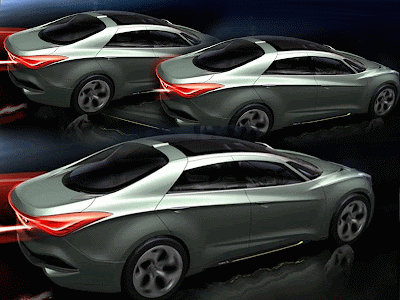
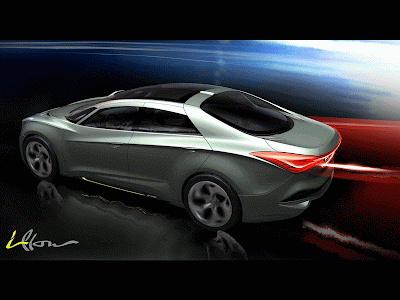
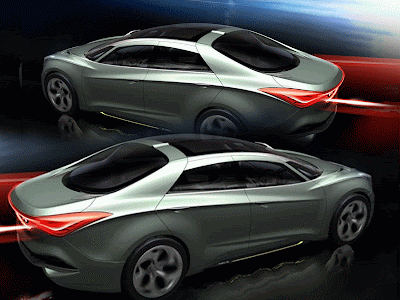
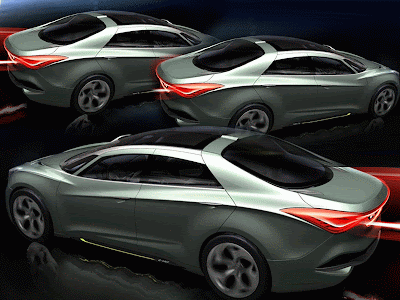
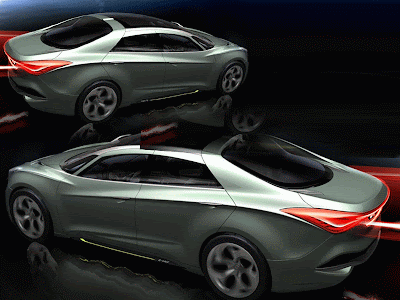
The Geneva Motor Show is quite generous in reveals this year, considering the trend of the automotive industry. Hyundai has just presented its new i-Flow Concept on the catwalk, continuing the company’s statement of developing a the “fluidic design”. As Hyundai continues to branch out into new segments, its European operation, which until recently has focused primarily on small cars, is debuting the Hyundai i-flow concept in Geneva. It's a vision of a coming Hyundai that's expected to do battle in Europe's larger D-segment.
2010 Hyundai i-Flow Concept Diesel-Electric Hybrid Powertrain
The i-flow is the latest concept to wear Hyundai's "fluidic sculpture" design language, and the large D-segment sedan wears it well. Hailing from Hyundai's European Design Headquarters in Russelsheim, Germany, the i-flow incorporates lightweight materials and solar cells from supplier BASF meant to reduce weight and increase energy efficiency.
2010 Hyundai i-Flow Concept Diesel-Electric Hybrid Powertrain
The i-flow is fitted with Hyundai's first-ever diesel hybrid drivetrain, in which a 1.7-liter diesel engine with dual-stage turbocharging is mated to Hyundai's Blue Drive hybrid system and a new six-speed dual-clutch gearbox. As we understand it, the i-flow is a parallel hybrid, allowing it to be powered by its lithium-polymer battery pack and electric motors, the diesel engine or a combination of both. Combined with a slippery 0.25 coefficient of drag, the i-flow will reportedly return 78.4 mpg and emit 0.30 grams of CO2 per mile.
2010 Hyundai i-Flow Concept Diesel-Electric Hybrid Powertrain
The new lines give an elegant avant-garde look, helping in the same time in reducing the CO2 emissions to 85g/km and improving its aerodynamics. In collaboration with chemical company BASF, Hyundai produced its first eco-friendly diesel hybrid powertrain, using high-technologies and next-generation materials. The new i-Flow combines perfectly the concept of a little-big car, as it shows a sporty looks but also provides quite enough space due to the use of a minimalistic design for the seats and center console.
2010 Hyundai i-Flow Concept Diesel-Electric Hybrid Powertrain
The high-tech engine presents the new 1.7-litre engine fitted with 2-stage turbocharging connected to a Lithium Ion-Polymer battery for a more efficient consumption, especially when driven i-flow’s six-speed, dual-clutch transmission. The i-Flow technology is a test bed for new energy harvesting ideas, ranging from flexible solar panel roofing to a thermo-electric generator which uses exhaust heat to produce power. More news of Hyundai’s star cars will be published in advance of the show and will be available on the stand.  The company’s press conference will take place in Hall 1 at 14:15 (CET) on Tuesday 2nd March  (2010).

Sunday, December 27, 2009

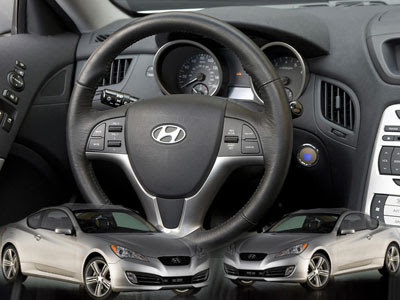
2010 Hyundai Genesis Sports Car Coupe with SHIFTRONIC to handle the additional torque

2010 Hyundai Genesis Sports Car Coupe

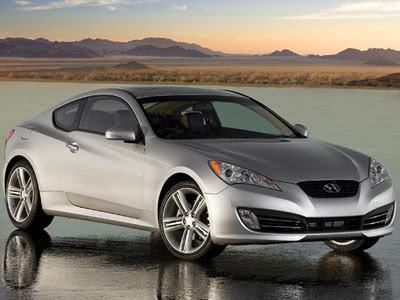
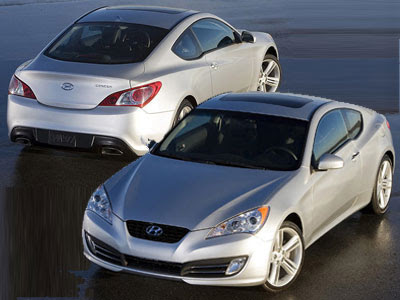
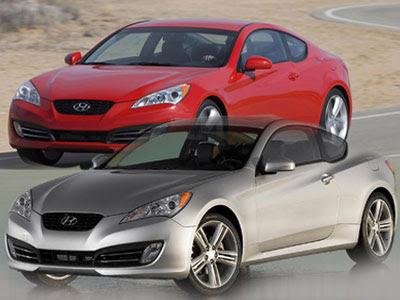
The people at South Korean automaker Hyundai are listening to their customers. The 2010 Hyundai Genesis Coupe, confirmed for production and a release early in 2009, follows the tradition of the 2009 Hyundai Genesis in offering a true high performance rear wheel drive, sporty architecture in an affordable package. The 2010 Genesis Coupe is a purpose-built rear-wheel drive sports coupe featuring two performance-focused engines - a212-horsepower 2.0-liter turbocharged four-cylinder engine and a range-topping all-aluminum 306-horsepower, DOHC 3.8-liter V6 engine.
2010 Hyundai Genesis Sports Car Coupe

Genesis Coupe employs a MacPherson strut dual-link front suspension and a five-link rear suspension setup. Both engines are mated to a standard six-speed manual transmission. The Genesis Coupe 2.0t (2.0-liter 4-cylinder turbo) offers an optional five-speed automatic with SHIFTRONIC® while the 3.8-liter V6 offers a ZF six-speed automatic transmission with SHIFTRONIC to handle the additional torque.
The Genesis Coupe follows the styling tradition set forth by the Hyundai Tiburon, but outdoes that aging Hyundai compact sports car in every way. The Genesis Coupe comes with an available naturally aspirated V6, sure to be a motor to find its way into more of Hyundai's lineup. The high output engine offers 310 horses on premium fuel. Following the introduction earlier this year of the rear-wheel drive Genesis sport sedan, Hyundai Genesis Coupe is Hyundai's most dynamic performance car ever and the second consecutive all-new model introduction from Hyundai appealing directly to the car enthusiast.
2010 Hyundai Genesis Sports Car Coupe

Hyundai Genesis Coupe uses the same flexible rear-wheel drive architecture originally developed for the Genesis sport sedan.
The 2010 Hyundai Genesis Coupe offers Xenon high-intensity discharge (HID) headlights. The advantages of HID headlamps include greater lighting power, daylight-type lighting and reduced power consumption. In addition, the cut lines of the new HID headlights are extremely precise, providing maximum nighttime visibility without distracting other drivers.
All Hyundai Genesis Coupe models feature standard four-channel ABS with Electronic Brake-force Distribution (EBD) to optimize brake performance under various dynamic loading conditions. The system also includes Brake Assist, which provides maximum ABS-level braking force when a panic stop is detected.
2010 Hyundai Genesis Sports Car Coupe

It is nice to see that Hyundai, an automaker currently enjoying growth and a solid reputation for producing mainstream-market cars that last, is making steps toward the sports car market. The styling of the Genesis Coupe is hit or miss, some will love it and others will wonder what Hyundai was thinking. But, with the sports car pedigree to back it up, the Genesis Coupe should be another worldwide hit for Hyundai.
2010 Hyundai Genesis Sports Car Coupe

The Hyundai Genesis Coupe is offered in three trim levels: the stylish and affordable GS, the premium-sport GT featuring the 3.8-liter V6, and the high-performance SE, available with either the 2.0-liter turbocharged four-cylinder engine or the 3.8-liter V6 engine.

Saturday, October 3, 2009

2010 Hyundai Sonata i40 Electric Hybrid Concept Car

2010 Hyundai Sonata i40 Electric Hybrid Concept Car

Hyundai
presented the next generation Sonata sedan, which is on the European market would be called i40.
2010 Hyundai Sonata gets a new platform and a different range of engines, which will include a series of turbo diesel “R” and the four-and six-cylinder petrol engines. It is also expected to modify the appearance of 228-strong hybrid that combines 2.0-liter turbo-charged (according to other sources - 2.4-liter) capacity of 30 kilowatt electric motor, lithium-ion batteries, and six-speed automatic transmission.
In the sale of novelty will appear early next year. According to some foreign publications in Europe, first to the market can go touring Hyundai i40, then hatchback, sedan and the hybrid version.